The Evolution of Wealth Management: And Where It’s Headed Next
It's no secret the wealth management industry is evolving. With the rise of AI, more access to information, and a desire for deeper meaning, we are at another critical inflection point.
Welcome to the first issue of the IWA Practice Management Newsletter.
One year ago, we launched the Integrative Wealth Advisor Certification. What has happened since has exceeded every expectation. We have built something real: a new model of advising that is human, meaningful, and effective.
Each month, this newsletter will bring you insights, frameworks, and practical tools to support your growth as a member of the Integrative Wealth Community.
None of this exists without you. Thank you for your contribution to this ecosystem. We are just getting started and can’t wait for all that’s ahead.
Let's dive in.
How We Got Here
To understand where we're going, it helps to understand where we’ve been.
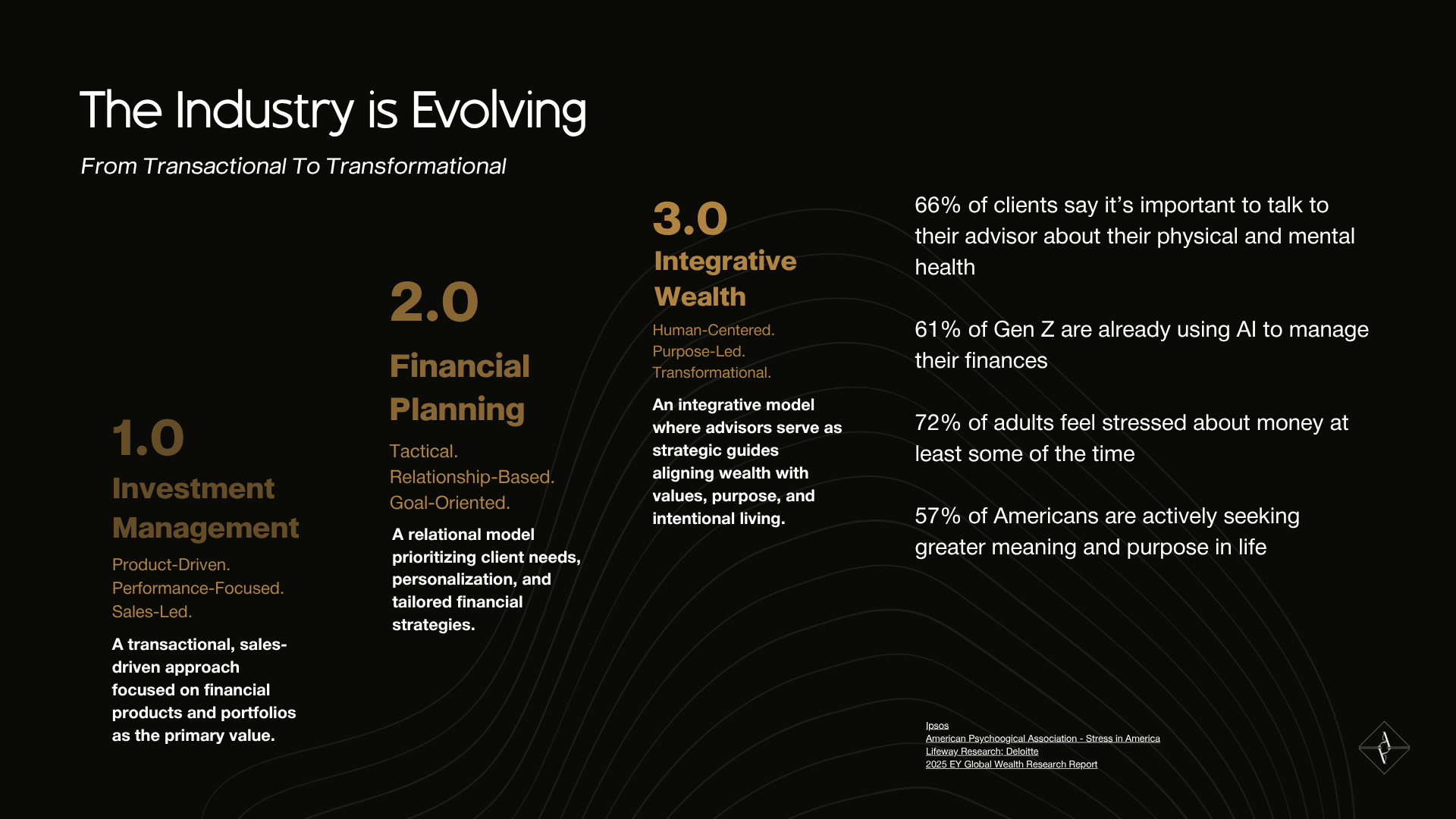
Wealth Management 1.0: Investment Management
At the onset of formal wealth management, financial advice was primarily about investment advice. Accessing the stock market was difficult for the everyday individual, and the knowledge gap between advisor and client was vast. It seemed to many like an insiders game.
Wealth management was product-driven, performance-focused, and sales-led. The value proposition was simple: generate returns. The client was often secondary to the portfolio, and conflicts of interest ran high. Advisors were often compensated for recommending certain products, regardless of whether it was in the client’s best interest. Relationships were transactional, and success was measured purely monetarily.
Since then, the investment management industry has evolved significantly. Investing has been democratized, fees have dropped, and financial education is more accessible. The shift from high-fee actively managed portfolios to low-cost indexing and evidence-based investing has been one of the great advancements of the modern financial era. Spending seven years at Dimensional, who pioneered the science of investing, it's no secret where I hang my hat.
Investments are the foundation of the house, and building a sensible approach has never been easier. But a sound investment strategy only works if the human behind it can execute it. Can clients stay in their seats during market volatility? Do they even know what their investments are ultimately for?
Wealth Management 2.0: Financial Planning
Eventually, a recognition emerged that individuals didn’t just need investment advice. They needed support planning for their financial futures. Financial planning opened the door to something more human: a discussion around goals and life stages. The client began to replace the product at the center of the equation. Advisors began building real relationships and tailoring strategies to individual circumstances.
And yet, something essential was, and still is, missing.
Financial planning expanded the conversation, but it didn't get to the heart of what all of it is for. Why are you saving and investing in the first place? What kind of life are you trying to build
A financial plan is only as good as its inputs. If you don’t know what kind of life you want to create, how do you know what goals to set or what to invest toward? You can have the most sophisticated plan on paper, but if the goals feeding it are unclear, disconnected from your actual values, or are constantly shifting due to unexamined patterns, you either won’t be able to stick to the plan or the outcome won’t be what you actually desired.
Today, wealth is still widely viewed as synonymous with money and the focus remains on accumulation. But accumulation toward what, and why?
The Forces Reshaping Our Industry Right Now
We are at a unique point in human history and several powerful shifts are converging simultaneously:
-
AI is transforming how clients access and manage financial information. 61% of Gen Z are already using AI to manage their finances.
-
Wellness and wealth are merging. 66% of clients say it's important to talk to their advisor about their physical and mental health.
-
Financial stress remains pervasive despite increased wealth. 72% of adults feel stressed about money at least some of the time.
-
A cultural shift toward meaning is underway. 57% of Americans are actively seeking greater meaning and purpose in life.
-
A generational wealth transfer is bringing new values, new expectations, and new definitions of success.
The message is clear: people are seeking more than traditional wealth management has offered. They are seeking alignment. They want their financial lives to reflect who they are, what they value, and where they are going.
The advisor who can meet that need will lead the next era of this profession. The convergence of these forces is not a threat to the profession but an invitation to evolve it.
2 American Psychoogical Association - Stress in America
3 Lifeway Research; Deloitte
4 2025 EY Global Wealth Research Report
The Next Frontier: Integrative Wealth
Human-Centered. Purpose-Led. Transformational.
Integrative Wealth was born from the recognition that the equation we’ve been trying to solve is not the right one. Instead of asking “how do we make someone more money?” the better questions to ask are: What do you actually want out of life? What does wealth mean to you? How can you align your resources accordingly?
It starts by redefining what wealth actually means.
The word wealth comes from the Old English word “welle” meaning wellbeing. I’ve now asked hundreds of people to define what it means to them to be wealthy and not one has answered money alone. While money is often part of the equation, I’ve found most people define wealth as a mix of peace of mind, contentment, joy, living a life in accordance with their purpose, and providing for those they love.
Integrative Wealth begins here, with this ecosystemic view, recognizing that wealth is more than money.
Just as Functional Medicine moved healthcare beyond symptom treatment to system-level understanding, Integrative Wealth does the same and moves wealth beyond accumulation to alignment. A balance sheet shows assets. It does not reveal the coherence of the human system beneath it. In the same way, a number on a scale doesn't define health, net worth alone does not define wealth.
An Integrative Wealth Advisor is trained to assess and align the internal architecture of a human being — the one that produces financial behavior, addressing not just what clients own, but how they perceive value, make decisions, allocate resources, and design their lives.
Money challenges are rarely just financial. They are expressions of misalignment beneath the surface: identity conflicts, unclear values, distorted priorities, and decision patterns that have never been examined. When the human system is aligned, everything downstream becomes more effective, including financial strategy. Financial plans become more meaningful because the inputs are chosen intentionally, not delivered ad hoc.
The goal of Integrative Wealth is to support the evolution of a person's internal operating system and the alignment of their external resources so that money is experienced as a tool, not an identity. Wealth becomes a state of being rather than a number to achieve. And individuals cultivate the clarity, coherence, and self-trust to align their identity, resources, and decisions in service of their full potential.
The Human Case is the Business Case
For too long, we've been taught that being more human comes at the cost of professional performance. That narrative is breaking down.
More than ever before, people are craving connection, meaning, and depth. And ironically, no one is more aptly positioned to meet that need than financial advisors. Money is one of the most sensitive, emotionally charged topics in a person’s life. The advisor who can hold that conversation with skill and presence opens a door that few other professionals can.
The advisors who will lead this next era are not the ones racing to out-optimize AI or replicate a cookie-cutter model. They are the ones who bring their full intelligence, analytical and human, to every client relationship. Who guide conversations that go beyond spreadsheets into values, identity, and purpose. Who understand that when a client feels truly seen and heard, trust deepens, relationships last, and impact expands.
Where Are You In Your Evolution
Integrative Wealth offers a new and different path. It’s built on a foundation that requires you, the advisor, to do this work yourself. With the recognition that you can not lead others to places you have not gone.
Before frameworks and client tools, Integrative Wealth asks you to examine your own relationship with money, success, time, and self-worth. The clarity you cultivate internally becomes the foundation for how effectively you can guide others.
A few questions worth sitting with to determine if this approach is right for you:
→ What does living a wealthy life mean to you?
→ What are you here to manage as a “wealth manager”?
→ What kind of impact do you want to create in the lives of your clients?
If the answers to these questions point to more than money, and you sense that there is a more aligned, impactful, fulfilling version of your practice waiting to be built, Integrative Wealth was designed for you.
Community Wins: Seeing this Work in Practice
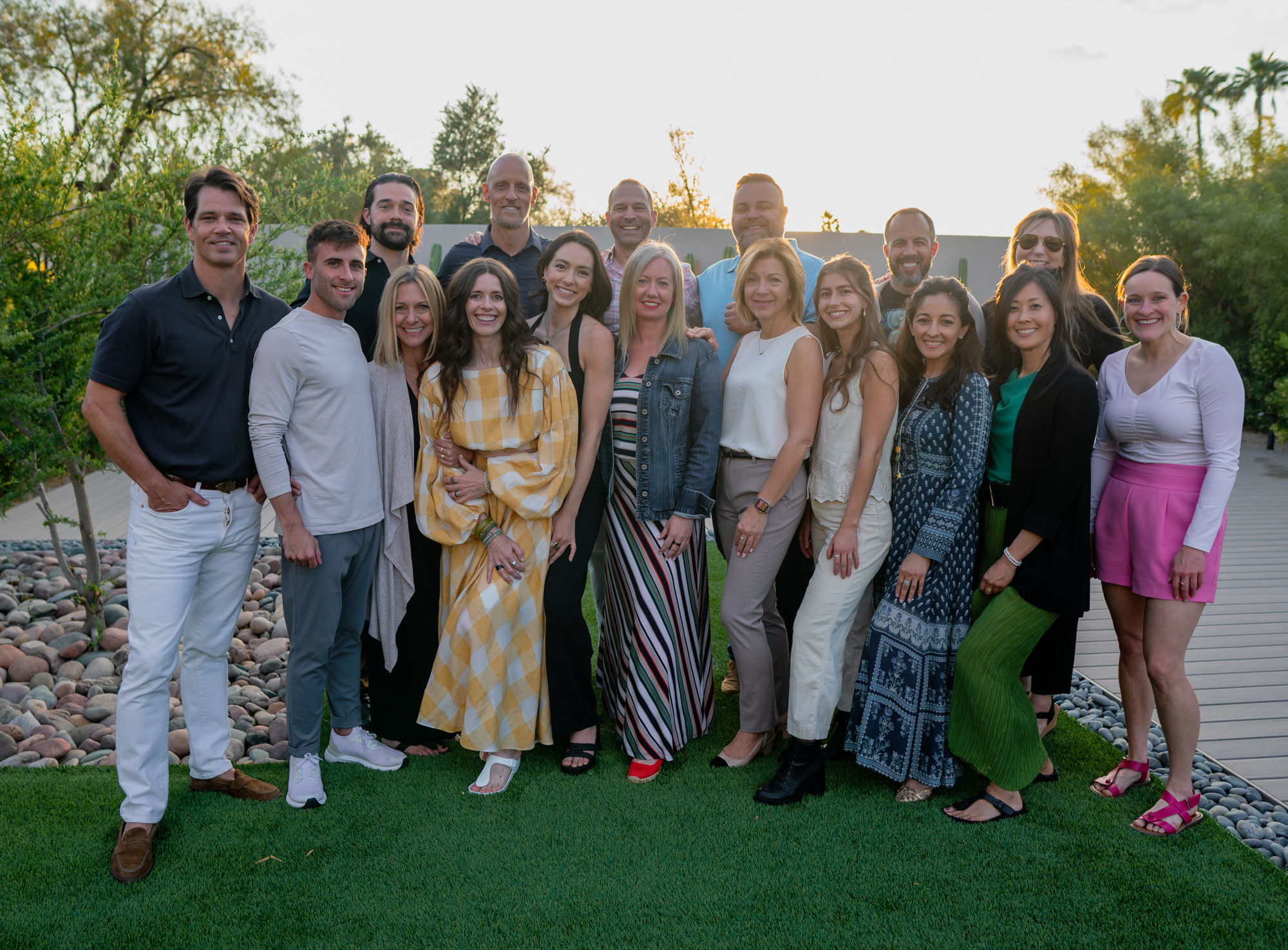
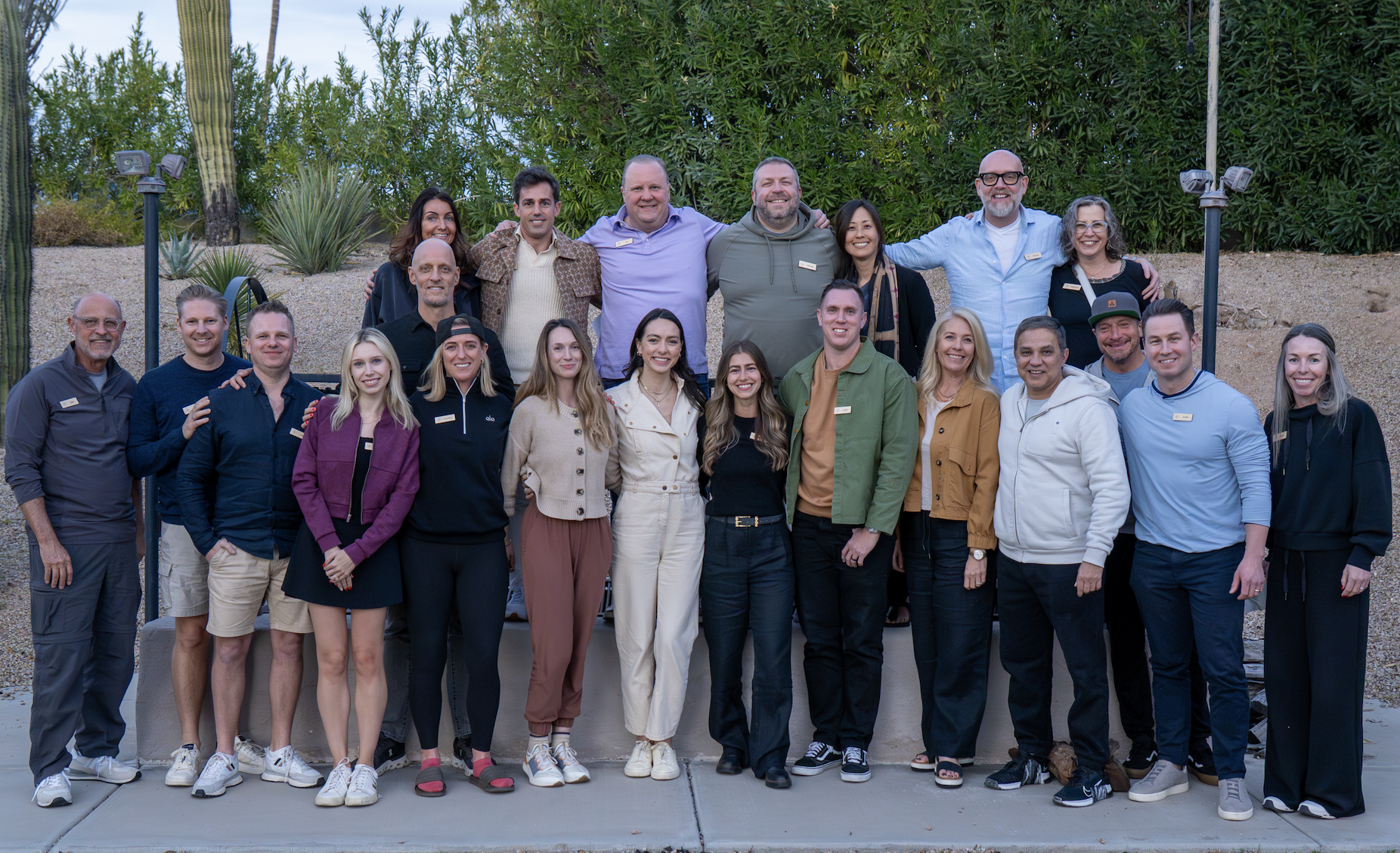
In 2025, we held the founding cohort of the Integrative Wealth Advisor Certification. Now, halfway through the 2026 IWA Cohort, we’ve witnessed something profound.
We are excited to use this space to celebrate specific wins in the Integrative Wealth Community (reply to this email with your win to be featured in the community.
They say a picture is worth a thousand words so for our first issue we’ll leave you with these from our 2025 and 2026 cohorts:
Ready to Go Deeper?
→ Listen to EP 29 of the Human Evolution Podcast: The Role of Money in Human Evolution
An exploration of the philosophy behind how wealth and money have shaped society.